

19 Nov 10 Oh Noes! I’m Outing Facebook Ads

I just saw this ad on Facebook and love how attention grabbing this ad is, especially since it’s written in a way to connect with a very specific target audience.
However, immediately after enjoying how smart and witty the ad was, the next thing that popped into my mind was:
“Wait a minute, why am I even seeing this ad running, did the reviewer ‘forget’ about section 15 of the Facebook ad guidelines?” http://www.facebook.com/ad_guidelines.php
Here’s a Snippet From Section 15 of the Ads Guide and also a screenshot of the Ads FAQ that explains this further with an example:
Grammar, sentence structure, spelling, and spacing
Ad text must be grammatically correct and contain proper sentence structure.
Ad text must be in complete sentences.
Ads cannot include excessive repetition (such as “buy, buy, buy”).
Ads must use correct spelling.
Ad text must include grammatically correct spacing.
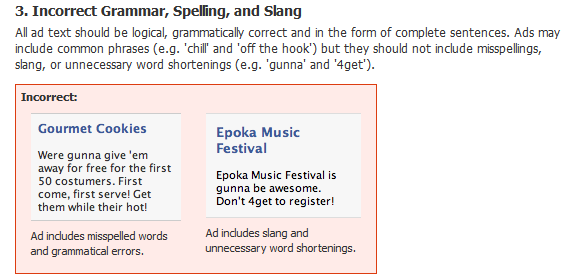
Screenshot of Ads Faq
What are your thoughts on this?
Is it ok for Facebook to allow a company like Panasonic to break the ads guideline or operate under a different set of guidelines, when a similar move by a smaller advertiser would be met by the very familiar disapprove message that I’m sure many of you reading this post have grown to love (to hate)?
18 Oct 10 The New Prosper202 Tokens: Cool Stuff You Never Knew Was Possible
Since the introduction of the new [[subid]], [[C1]], [[C2]], [[C3]] & [[C4]] tokens in Prosper202 there hasn’t been much in terms of official documentation of how to best make use of them. This is quite unfortunate because these new tokens and internal prosper202 functionality updates actually quite powerful once you fully understand what you can do with them. This post goes into some of the power user features that were added, but never fully documented and explained.
Let’s Start With The Basics: [[subid]]
Before the most recent updates, you would have to rearrange your affiliate links to ensure your subid variable was at the end of your url
For example a link like the following:
http://somenetwork.com/redirect.php?a=CD12345&subid1=&b=9315&optinfo=&d=0&l=0&p=0
Would have to be rewritten as:
http://somenetwork.com/redirect.php?a=CD12345&b=9315&optinfo=&d=0&l=0&p=0&subid1=
For many people this was a huge point of failure,and we saw more support tickets and emails about errors caused by the incorrect formatting of the affiliate link than anyone should be subject to.
So now using the [[subid]] token on Prosper202 1.5 and higher, getting your link formatted correctly is as simple as grabbing your affiliate link and pasting the [[subid]] token right after the subid variable.
An example is shown below:
http://somenetwork.com/redirect.php?a=CD12345&subid1=[[subid]]&b=9315&optinfo=&d=0&l=0&p=0
For the average, and not so average user, this is a major improvement and a much simpler non technical way to format affiliate links for correct tracking.
Now About The New [[C1]],[[C2]],[[C3]], and [[C4]] Variables and Tokens
For a while now, the only way to pass extra data into the software was with the t202kw variable on the tracking link generated in step 7
Here’s an example link:
http://tracking202.com/tracking202/redirect/dl.php?t202id=8373&t202kw=myKeyword
In the beginning, this was flexible enough. But, as the software started being used for media buys, email drops, ppv and social advertising etc, there was a need for more tracking parameters. That’s where the C1-4 Variables become really useful.
There are 2 main places you can use the C Variables, in step #3 you can use them as tokens and in step #7 they are available as url variables.
Let’s take a look at the simple way of using the C1-4 Variable and then go on to the more advanced feature, one that I assume many of our users may not have known existed.
During step #7 as you create your tracking link you can use the forms to append up to 4 C variables to your tracking link. Think of them the same as you would the t202kw variable.
For example on a facebook campaign you may use C1 to track the gender, C2 to track the age range, C3 for the ad creative and C4 for you bid type. Here’s how the link may be formatted

In this example we are using the C1-4 variables to track different factors of a Facebook campaign.
The prosper202 interface in step #7 is just there to allow you to easily add these tracking variables, so you can actually manually append these to your links after you generate them. This works great for ad network tags like {placement} on adwords.
To view and analyze the performance of your campaigns you’d use the new group overview screen. Using this screen you can group your reports by any number of factors.

Use the new group overview tab to analyze performance
Getting More Fancy – Dynamic Variable Passing
Have you ever had a situation where you needed to pass dynamic values into your affiliate link? Until version 1.5 this was basically impossible unless you really hacked some code. This is definitely out of the question for most of of our users.
But with the new and hardly documented variable passing system, this is a breeze.
Take a look at this example:
http://somenetwork.com/redirect.php?a=CD12345&subid1=[[subid]]&b=9315&optinfo=&d=0&l=0&p=0&subid2=[[c1]]
I added a subid2 variable and placed the [[c1]] variable as its value. One big thing to notice is that, the [[c1]]-[[c4]] tokens DON’T have to be assigned to a corresponding c1-4 url variable in your link in step #3. Any of the following are completely valid
http://somenetwork.com/redirect.php?a=CD12345&subid1=[[subid]]&b=9315&optinfo=&d=0&l=0&p=0&age=[[c1]]
http://somenetwork.com/redirect.php?a=CD12345&subid1=[[subid]]&b=9315&optinfo=&d=0&l=0&p=0&c1=[[c1]]
http://somenetwork.com/redirect.php?a=CD12345&subid1=[[subid]]&b=9315&optinfo=&d=0&l=0&p=0&gender=[[c1]]&age=[[c2]]
http://somenetwork.com/redirect.php?a=CD12345&subid1=[[subid]]&b=9315&optinfo=&d=0&l=0&p=0&gender=[[c1]]&age=[[c2]]&location=[[c3]]&specialsauce=[[c4]]
Now the question is, where does the c1-4 values come from? You pass them in on the fly via your tracking link generated in step #7
Here’s an example of how this would work:
http://tracking202.com/tracking202/redirect/dl.php?t202id=8373&c1=female&c2=21-26&c3=usa&c4=not-telling&t202kw=myKeyword
When the link above is clicked Prosper202 would automatically perform the following substitutions (assuming your affiliate link in step #3 was: http://somenetwork.com/redirect.php?a=CD12345&subid1=[[subid]]&b=9315&optinfo=&d=0&l=0&p=0&gender=[[c1]]&age=[[c2]]&location=[[c3]]&specialsauce=[[c4]] ):
http://somenetwork.com/redirect.php?a=CD12345&subid1=[[subid]]&b=9315&optinfo=&d=0&l=0&p=0&gender=female&age=21-26&location=usa&specialsauce=not-telling
[[c1]] was replaced by “female”, [[c2]] by “21-26”, [[c3]] by “usa” and [[c4]] by “not-telling”
As you can see, with a little imagination, there are quite a few cool things you can do with this new functionality.
Hot Tip: In all my examples, I didn’t bother trying to encode my c1-4 values. Ideally you’d create an encoding for all these values to prevent competitors from knowing exactly how you are targeting your traffic.
UPDATE: Thanks Wes Brooks for reminding more of this cool mod that makes it easier to use the new tokens: http://ctrtard.com/affiliate-marketing/pimp-your-prosper-with-subid-injection-buttons/
Tags: Adwords, Facebook, Google, Media Buying, Prosper202, Tracking202
09 Sep 10 Social Proof Is King Especially on Facebook

I’m Nana Gilbert-Baffoe and I Endorse this blog post!
As a marketer you should know about the psychological phenomenon known as social proof and its power and ability to get people taking action or feeling more comfortable about taking an action because they see other people have already taken a similar action. Social proof becomes even more powerful when people you know, like and trust endorse an action or product and Facebook ads includes an incredible ability to tap into this phenomenon with Social Endorsement. To see how social endorsements work on ads, take a look at the image to the left.
How many of you could resist from clicking my ad or even liking it too if you knew someone as likable, charismatic, and humble as me was endorsing my own ad?
So the ability to click like on ads is not new, but until today all you could do is assume and hope that someone (hopefully someone influential) had clicked the like button. There was no way to actually know how people were engaging with your ads and if anyone had actually taken to time to click Like on your ads.
Take a look at the new data Facebook just made available to advertisers
 In a note today the FB ads team announced that we now have access to some pretty interesting data on how people are interacting with our ads and if anyone has clicked like, it doesn’t have all the data I’d like to see, but it’s definitely a start in the right direction.
There ad manager now shows one new column labeled Social %, this shows the percentage of ads that were shown with asocial endorsement at the bottom. To get access to all the extra metrics you see in the screen shot, you will need to run an Advertising Performance report in the report manger. In the image the Impressions column is nothing new, but right next to it we have Social Imp % which is the same as the Social % metric shown in the ad manager. The next new metric is Social Clicks, this shows how many clicks originated from ads with social endorsements on them. The final and more interesting to me is the Social Click Rate one. I had always guessed that ads with social endorsements enjoyed a higher CTR but there was no way to really know. Now we know. I chose to share data from a campaign with enough data that my conclusions would be more statistically valid. If my math is correct, having social endorsement on my ads increased my CTR by over 41%. This is huge, and I’m going to start experimenting with ways to get more social endorsements on my ads.
It would be interesting to get some more data from others as to how much better or worse your ads performed when enhanced with social endorsements, feel free to share your data in the comments. Hint, Hint! Additionally I’d like to see the actual number of endorsements my ads got and how well these ads improved conversion rates. The conversion data would only be available to people using the Facebook conversion pixel. I’m sure Facebook will add this over time.
Tags: Facebook
05 Sep 10 Cheap Facebook Traffic For The Taking
 For many of us in the US, it’s easy to forget or not realize that 70%+ percent of Facebook’s 500+ million active users are NOT in the US. This means that if you have a product or service that can be used by the international web, you need a plan for utilizing Facebook’s relatively cheap international traffic to grow your bottom line. This short guide will provide you with a few pointers on how to best advertise to non-US Facebookers and also show you where to go to get the cheapest international traffic.
Watch your language!
Is the landing page of the offer in English or another language? Remember, it’s possible to target people by both language and country, so ensure the language of the page matches up with the language selected your ad. By default, facebook will target your ads to speakers of the official language of the country you are targeting, don’t make the mistake of writing an English ad that may potentially be shown to a non-English speaker. You will only end up with a low CTR ad. It’s safe to assume that many of you reading this may not be native speakers of some of the offer you promote. Use a tool such as Google Translate to help you. http://translate.google.com/
Find The Right Offers
Ask your affiliate manager at your favorite network for a list of their top international offers. They are there to help you, so make use of them as a resource. Just a few months ago, it was much harder to find offers to run internationally. Now almost all the major networks have a reasonable collection of international offers, often they are available for countries other than the usual countries that everyone things of when looking to promote “International” offers i.e. Canada, UK, Australia, and even New Zealand so explore and be adventurous with your offer selection.
Geo Targeting Can Be Your Enemy
Many savvy advertisers and affiliates use scripts to automatically redirect non-locals to another page. This can backfire especially with Facebook because they will disapprove your ad if they don’t land on a page that matches the offer being presented in your ad. One solution is to ask your affiliate manager if there is non-geotargeted link available for use on Facebook. There are other ways to solve this problem; however I won’t recommend them since it could get your account banned.
Know Where The Cheap Traffic Is
Even though 70% of Facebook’s active users are not in the US, it’s still worth noting that the US still has the largest concentration on Facebook users for targeting. Compare over 132,000,000 users in the US vs approximately 28,000,000 in the UK which is the country with the next largest userbase reachable by advertisers. We are talking about almost 5x more users to advertise to but it comes at a premium. US traffic is the most expensive and competitive to target on Facebook. The recommend CPC for targeting people 25-34 is about $1.12 in the US, however if you were trying to reach the same age demographic in Venezuela you’d be paying only $0.11 this is approximately 10x cheaper.
Here’s a table with the Top 10 Facebook Countries By Traffic Volume and the cost of reaching people aged 25-34 in each country. All data is approximate.
| Rank | Country | # of Facebook Users | Cost To Target 25-34 Yr Olds | # Of 25-34 Yr Olds |
| 1 | USA | 132,810,940 | $1.12 | 32,486,140 |
| 2 | UK | 27,806,860 | $1.08 | 7,369,060 |
| 3 | Indonesia | 27,338,560 | $0.23 | 6,100,040 |
| 4 | Turkey | 23,516,140 | $0.14 | 6,982,240 |
| 5 | France | 19,444,660 | $0.61 | 5,290,420 |
| 6 | Italy | 16,888,600 | $0.32 | 4,631,380 |
| 7 | Philippines | 16,235,000 | $0.12 | 3,814,360 |
| 8 | Canada | 16,199,840 | $0.74 | 4,236,660 |
| 9 | Mexico | 15,037,020 | $0.17 | 3,910,700 |
| 10 | India | 13,188,580 | $0.35 | 4,007,160 |
Would you like a word doc with the top 30 countries? Here’s how to get the file:
Step 1: Like this post in Facebook
Step 2: Tweet this post on twitter.
Step 3: My Facebook fanpage is a bit lonely. “Please Like Me” 🙂 And A link to the word doc will be automatically shown to you.
Tags: Facebook, International Traffic

